Silicon Valley vs. Cape Canaveral: Who's Really Going to Get Us to Mars First?
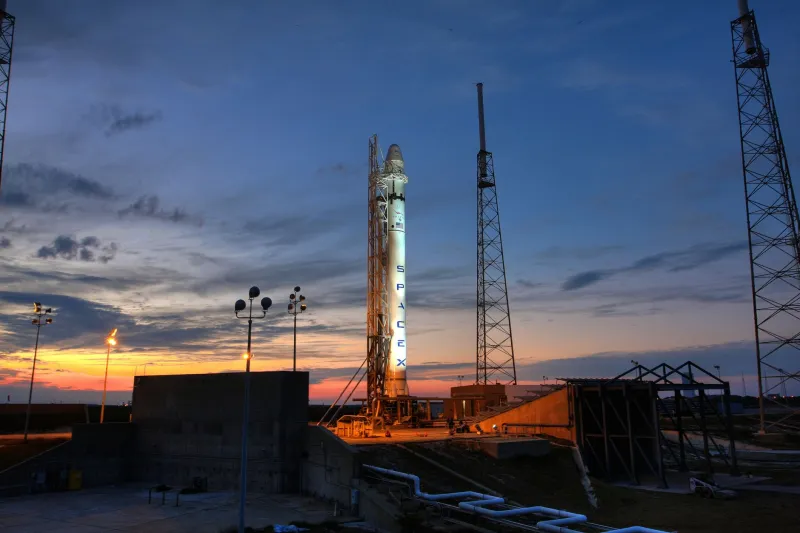
For most of the 20th century, the idea of going to Mars was a government project — a dream that lived inside NASA's massive bureaucracy, congressional budgets, and decades-long mission timelines. Then something shifted. A billionaire from South Africa started building rockets in a warehouse in California, and suddenly the whole equation changed.
Today, the race to Mars looks nothing like the Apollo era. It's messier, faster, louder — and honestly? A lot more interesting.
The Old Playbook Isn't Working Anymore
NASA has been talking about sending humans to Mars since the 1960s. The agency has produced roadmaps, white papers, and concept missions by the dozens. But actual hardware headed for the Martian surface? That's been a much slower story.
The reasons are understandable. NASA operates under the weight of federal oversight, shifting political priorities, and a mandate to be conservative with taxpayer money. When administrations change, so do mission priorities. The Constellation program — once NASA's ticket back to the Moon and eventually Mars — was cancelled in 2010 after billions had already been spent. The Space Launch System (SLS), NASA's current heavy-lift rocket, has faced years of delays and cost overruns that would make any private CFO wince.
That's not a knock on NASA's engineers, who are genuinely brilliant. It's a structural problem baked into how government agencies operate.
Enter the Disruptors
SpaceX changed the math in a fundamental way. When Elon Musk founded the company in 2002, the goal was never just to make a better rocket — it was to make humanity multiplanetary, specifically by colonizing Mars. That singular focus has driven some genuinely jaw-dropping engineering decisions.
The Starship rocket, currently undergoing test flights out of Boca Chica, Texas, is designed from the ground up for Mars missions. It's fully reusable, which is the key to making interplanetary travel economically viable. SpaceX has already demonstrated rapid iteration — something NASA's procurement process simply can't match. When a Starship prototype explodes on the pad, SpaceX treats it as data. When a government rocket fails, it triggers congressional hearings.
Blue Origin, Jeff Bezos's aerospace company, is taking a longer-game approach. Its New Glenn rocket is now operational, and the company has been quietly building deep-space infrastructure technology. Blue Origin tends to be less flashy than SpaceX, but it's well-funded and serious about its long-term ambitions beyond low Earth orbit.
Then there's Axiom Space, which is carving out a unique lane. Rather than building Mars rockets, Axiom is focused on commercial space stations and private astronaut missions — essentially building the human infrastructure that any serious Mars program will eventually need. Their work with NASA on the International Space Station is already producing real results.
The Money Question
Here's where things get really interesting. NASA's annual budget hovers around $25 billion — substantial by any measure, but spread across Earth science, aeronautics, planetary science, and human spaceflight. SpaceX, meanwhile, has been valued at over $200 billion and has the flexibility to pour resources into Mars-specific technology without needing to justify every dollar to a congressional subcommittee.
Private investment in the space sector hit record highs in recent years, with venture capital and private equity flowing into launch companies, satellite operators, and deep-space technology firms. That capital doesn't come with the strings that government funding does, which means faster decisions and more aggressive timelines.
But it's not a completely lopsided story. NASA brings things that no private company can easily replicate: decades of institutional knowledge, a global network of research partnerships, and the kind of scientific credibility that matters when you're asking the world to trust your life-support systems. The agency also funds a huge portion of the research that commercial companies then commercialize — so the relationship is more symbiotic than it might appear.
Competition or Collaboration?
The smartest observers of the space industry will tell you this isn't really an either/or situation. NASA and commercial companies have developed a productive, if occasionally awkward, partnership. The Commercial Crew Program, which funds SpaceX and Boeing to ferry astronauts to the ISS, is a model for how government and private industry can divide responsibilities effectively.
For Mars, a similar dynamic is likely. NASA's scientific expertise — in areas like planetary geology, radiation biology, and life support — will be essential for any crewed mission that actually wants to keep its crew alive. SpaceX's engineering speed and cost efficiency will be what gets the hardware off the ground.
What's genuinely new is the sense of urgency. SpaceX has publicly stated ambitions to launch uncrewed Starship missions to Mars as early as the late 2020s, with crewed missions potentially following in the 2030s. Whether those timelines hold is another question — SpaceX has a history of optimistic scheduling — but the fact that they're achievable at all in that timeframe is remarkable.
What This Means for the Next Generation
For students and young space enthusiasts across the US, this moment is genuinely exciting. The job market in aerospace has never been more diverse. You don't have to dream of being a NASA astronaut anymore — you could be an engineer at a startup building Mars habitat prototypes, a data scientist processing telemetry from a commercial lunar lander, or a mission planner at a company that didn't exist five years ago.
The expansion of the space economy also means more pathways into the field. Coding skills, biology, geology, psychology — Mars is going to need all of it. The dawn of a new space age isn't just about rockets. It's about building a civilization somewhere else, and that requires every kind of expertise humanity has.
NASA isn't going anywhere. But it's no longer the only game in town, and that's probably good news for all of us who want to see humans standing on Martian soil before the century is out.