A Flash in the Dark: The Race to Crack the Code of Fast Radio Bursts
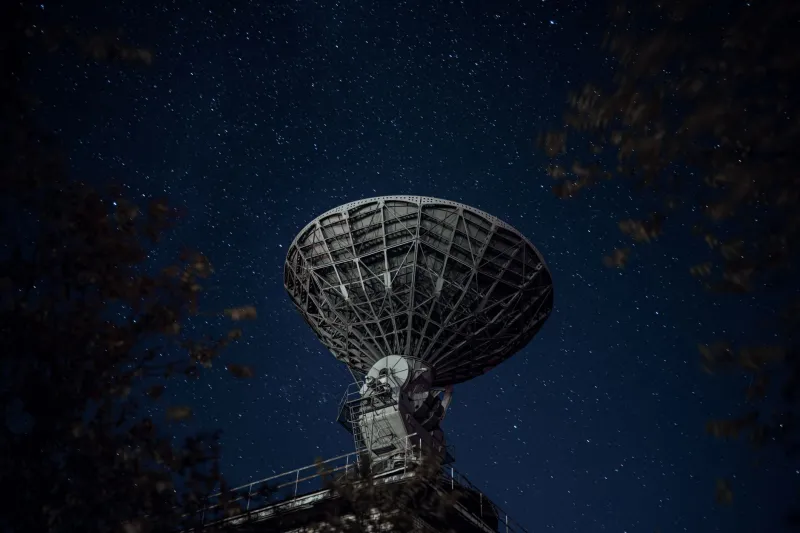
Imagine standing in a pitch-black field on a moonless night. For just a heartbeat — less than the blink of an eye — a light flares somewhere out in the darkness and disappears. You're not sure where it came from. You're not even totally sure what you saw. Now imagine that flash carried more raw energy than the Sun will put out over its entire lifetime.
That's essentially what astronomers are dealing with when they talk about fast radio bursts, or FRBs. These millisecond-long pulses of radio waves have been confounding the scientific community since the first one was accidentally discovered in archived telescope data back in 2007. More than fifteen years later, researchers are still piecing together what — or who — is behind them.
What Exactly Is a Fast Radio Burst?
At their core, FRBs are intense flashes of radio waves that show up seemingly at random from various corners of the sky. They last anywhere from a fraction of a millisecond to a few milliseconds. That's shorter than it takes you to process a single frame of a movie. Yet in that impossibly brief window, they release energy equivalent to what our entire Sun radiates in three days — packed into a single burst.
What makes them even more maddening is how they scatter. Radio waves traveling through the thin plasma that fills intergalactic space get smeared out by frequency — lower frequencies arrive slightly later than higher ones. By measuring that smearing, called dispersion, astronomers can estimate how far the burst traveled. Most FRBs appear to come from galaxies billions of light-years away. A few, however, seem to originate much closer to home.
The Discovery That Changed Everything
For years, every detected FRB was a one-and-done event — a single flash with no repeat performance. That made pinpointing sources almost impossible. Then, in 2016, researchers announced something remarkable: FRB 121102, a burst that kept coming back. This "repeater" gave scientists a fixed point in the sky to study, and eventually they traced it to a dwarf galaxy about three billion light-years away.
That was a turning point. Suddenly the field had a real target. Since then, more repeating FRBs have been identified, and the CHIME telescope in British Columbia — a massive radio telescope that looks like a collection of enormous skateboard half-pipes — has become one of the world's most productive FRB-hunting machines, cataloging hundreds of new events.
In 2020, the story took an even wilder turn. Scientists detected a fast radio burst originating from within our own Milky Way galaxy, coming from a type of neutron star called a magnetar — specifically one designated SGR 1935+2154. That single event strongly suggested that at least some FRBs are produced by magnetars, the most magnetically powerful objects known to science. But here's the catch: it probably doesn't explain all of them.
The Leading Theories (And Why None of Them Fully Fit)
Magnetars are currently the frontrunner explanation, and for good reason. These are the collapsed cores of massive stars, roughly the size of a city but packing more mass than the Sun, wrapped in magnetic fields trillions of times stronger than Earth's. When a magnetar's crust cracks under its own magnetic stress — a "starquake" — it can release enormous amounts of energy in a very short time. That tracks with FRB timescales.
But magnetars alone don't explain every FRB on the books. Some bursts show repeating patterns that seem almost rhythmic, hinting at a rotating object or an orbital period. Others appear to come from environments very different from where you'd typically find magnetars. A handful of competing theories are still very much in play:
- Colliding neutron stars — the same violent mergers that produce gravitational waves could also generate radio bursts in their final moments.
- Cosmic strings — hypothetical remnants of the early universe that, if they exist, could snap and release enormous energy.
- Compact object interactions — a neutron star orbiting a black hole, with the magnetic field lines periodically connecting and snapping like a rubber band.
Some fringe researchers — and it's worth emphasizing the word fringe here — have even floated the idea that the sheer regularity of certain bursts could point to artificial origins. The scientific consensus treats this as extremely unlikely, but it does illustrate just how strange and unexplained these signals remain.
Closer Than We Thought?
One of the more surprising recent developments is the growing suspicion that FRBs might be far more common than the original detection rates suggested. Early radio telescopes only caught the brightest, most distant events. As instruments have improved, researchers are picking up fainter signals — and some of those are turning out to be much closer to us than expected.
There's also mounting evidence that the Milky Way itself could be producing FRBs we're simply not positioned to detect well, since looking inward through the dense gas of our own galaxy is like trying to read a sign through a fog machine. Improved sky surveys and next-generation radio arrays are starting to change that picture.
The CHIME/FRB collaboration has been releasing catalogs of bursts at a rate that would have seemed impossible just a decade ago. Meanwhile, projects like the Deep Synoptic Array in California and the MeerKAT telescope in South Africa are joining the hunt, each bringing different strengths to the table. It's becoming a genuinely international effort.
Why It Matters Beyond the Mystery
Even setting aside the question of what's causing FRBs, these signals are turning out to be incredibly useful scientific tools. Because they travel across billions of light-years of space, they accumulate information about everything they pass through — the density of intergalactic gas, the distribution of matter in the universe, even the large-scale structure of the cosmos.
Astronomers have already used FRBs to help solve a long-standing puzzle: the so-called "missing baryon problem." For years, models of the universe predicted there should be more ordinary matter out there than we could actually account for. FRB dispersion measurements helped confirm that the missing matter is spread throughout the vast, nearly empty spaces between galaxies — essentially invisible to conventional telescopes but detectable through its effect on passing radio waves.
In other words, even if we never fully crack the mystery of what generates these bursts, they're already functioning as cosmic probes, giving us a tool to map the universe in ways we couldn't before.
What Comes Next
The next few years are shaping up to be a golden age for FRB research. The Square Kilometre Array — an enormous international radio telescope project spanning sites in South Africa and Australia — is set to come online in phases throughout this decade and promises to detect FRBs at a rate that will dwarf everything seen so far. When you're catching thousands of events instead of hundreds, patterns start to emerge that are simply invisible in smaller datasets.
For now, though, fast radio bursts remain one of astronomy's most compelling open questions. Each new detection adds a piece to the puzzle, and each piece seems to suggest the picture is even bigger and stranger than anyone first guessed. Whether they're the death screams of magnetars, the signatures of colliding stellar remnants, or something else entirely that we haven't thought of yet, one thing is clear: the universe has been sending us messages for a very long time. We're only just starting to learn how to listen.