How the James Webb Space Telescope Rewrote the Rulebook on Everything We Know About the Cosmos
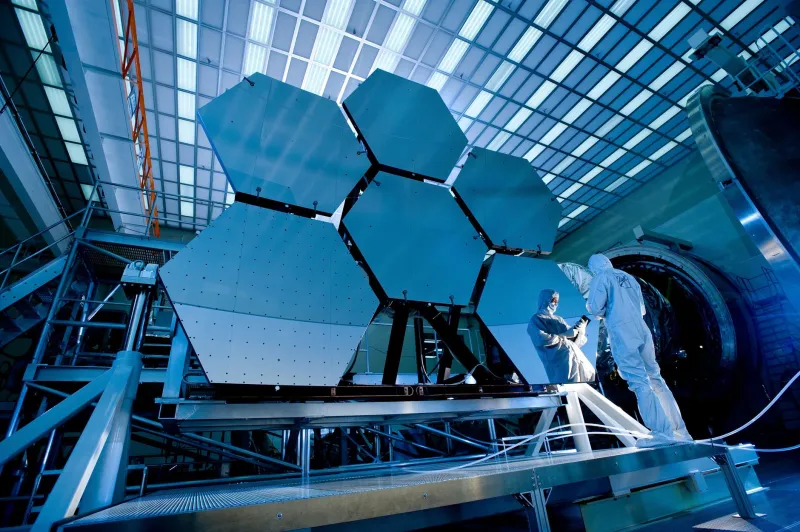
There's a moment in science when the data stops confirming what you expected and starts telling you something entirely different. For astronomers, that moment arrived — repeatedly — once the James Webb Space Telescope began sending back its first real observations. What started as excitement over sharper images quickly turned into something more profound: a genuine rethinking of how galaxies form, how planets become worlds, and how the universe itself has evolved over 13-plus billion years.
Let's dig into the biggest hits so far — the findings that didn't just make headlines but actually changed the conversation inside research labs and university lecture halls across the country.
Ancient Galaxies That Shouldn't Exist (But Do)
One of the earliest and most disorienting surprises from JWST came from the deep field images — those long-exposure shots that peer billions of light-years into the past. Astronomers expected to see the earliest galaxies as small, chaotic, and relatively dim. Instead, Webb revealed massive, surprisingly well-structured galaxies existing just a few hundred million years after the Big Bang.
These so-called "impossibly early" galaxies — some containing as many stars as our own Milky Way — shouldn't have had enough time to grow that large according to our standard models of cosmic evolution. The discovery sent theorists scrambling. Papers questioning the Lambda Cold Dark Matter model (the leading framework for how the universe's large-scale structure formed) started piling up almost immediately.
This isn't just an academic puzzle. If the earliest galaxies formed faster than our models predicted, it means we're missing something fundamental about how matter clumps together in the universe's infancy. That's a pretty big deal.
Reading the Air on Other Worlds
If the galaxy findings rattled cosmologists, Webb's work on exoplanet atmospheres has been equally game-changing for the astrobiology crowd. Using a technique called transmission spectroscopy — essentially measuring which wavelengths of starlight get filtered as a planet passes in front of its star — JWST has been dissecting the chemical makeup of alien skies with a level of detail that was simply impossible before.
The standout case so far is WASP-39b, a hot Saturn-like planet roughly 700 light-years away. Webb's observations of this world's atmosphere revealed carbon dioxide, sulfur dioxide, water vapor, and even evidence of photochemical reactions — chemical changes driven by starlight. For the first time, we were watching atmospheric chemistry happen on a planet outside our solar system in real time.
Then came the more tantalizing — and carefully caveated — detection of a potential biosignature on K2-18b, a sub-Neptune planet in the habitable zone of its star. Webb's instruments picked up hints of dimethyl sulfide, a molecule that on Earth is only produced by living organisms. Researchers were quick to pump the brakes and call for more observations before drawing any conclusions. But the fact that we're even having that conversation? That's entirely thanks to Webb.
Stellar Nurseries Like You've Never Seen Them
One of the most visually stunning — and scientifically rich — areas of Webb's work involves star-forming regions. Images of places like the Carina Nebula and the Pillars of Creation in the Eagle Nebula became cultural moments when they were released, but the science hiding inside those gorgeous images is just as compelling as the aesthetics.
Because Webb operates primarily in infrared wavelengths, it can peer through the thick clouds of gas and dust that typically block our view of stellar nurseries. What it found inside those clouds has given astronomers a clearer picture than ever of how stars — and by extension, planetary systems — are actually born.
In the Orion Nebula, Webb spotted dozens of free-floating planet-like objects called Jupiter Mass Binary Objects, or JuMBOs. These pairs of objects, too small to be stars and apparently not orbiting any star, were completely unexpected. Their existence has sparked new debates about planetary formation — specifically whether planets can form independently of a star system entirely.
A New Lens on Our Own Solar System
JWWS hasn't just been looking outward into deep time. It's also turned its gaze on our cosmic backyard with remarkable results. Detailed observations of Mars, Jupiter, Saturn's rings, Neptune, and several of their moons have added layers of nuance to our understanding of our own neighborhood.
Jupiter observations revealed never-before-seen auroras and atmospheric dynamics in extraordinary detail. Neptune's rings, which hadn't been clearly imaged since Voyager 2's flyby in 1989, appeared in Webb's infrared view with stunning clarity. And ongoing observations of ocean-bearing moons like Europa and Enceladus are helping scientists plan future missions by identifying the most scientifically promising targets.
Why All of This Matters Right Now
It's easy to look at Webb's discoveries as abstract scientific triumphs happening far removed from everyday life. But the questions it's answering — How did the universe get this way? Are we alone? How do worlds like ours form? — are about as fundamental as it gets for our species.
Webb is also a reminder of what long-term, high-investment science can accomplish. The telescope took decades to design and build, cost around $10 billion, and launched on Christmas Day 2021 after years of delays. There were plenty of moments when the project seemed cursed. Now it's rewriting textbooks.
For students interested in astronomy and space science, Webb's ongoing data releases represent an incredible opportunity. The raw data is publicly available through the Mikulski Archive for Space Telescopes, and citizen science projects are already helping researchers sift through it. You don't have to be at a major research university to engage with what Webb is finding.
The Story Is Still Being Written
Webb is designed to operate for at least 20 years, and it still has most of its fuel thanks to an incredibly precise launch. That means the discoveries covered here are genuinely just the opening chapters. Upcoming observations are targeting everything from the atmospheres of potentially habitable rocky planets to the environments around supermassive black holes at the centers of distant galaxies.
Every few months, a new result comes out that shifts the conversation. That's not a sign of science being broken — it's science working exactly as it should, with better instruments revealing a universe more complex and surprising than our best guesses had imagined.
The dawn of the Webb era isn't just a new chapter in astronomy. It's a reminder that the universe still has plenty left to teach us — and that we're finally building the tools good enough to listen.