Nature's Own Telescope: How the Universe Bends Light to Show Us Its Earliest Moments
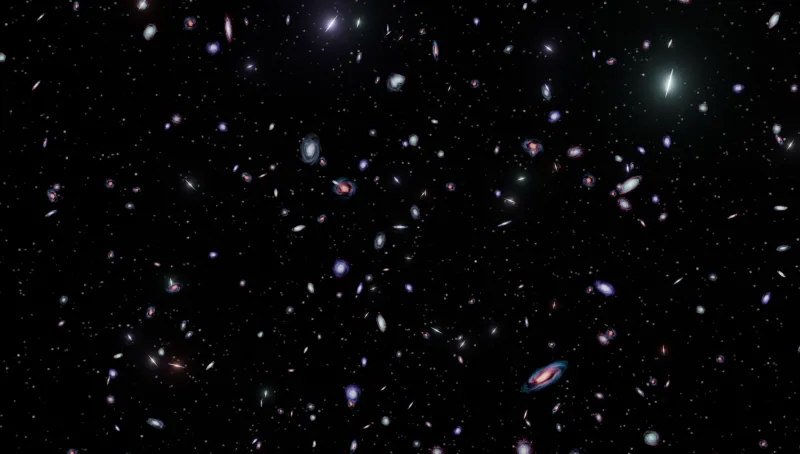
Imagine pointing a telescope at the sky and realizing the universe itself had already set up a better one for you. That's essentially what astronomers are discovering as they lean into one of the most mind-bending phenomena in all of physics: gravitational lensing. It sounds like something out of a sci-fi novel, but it's very real — and it's giving us a front-row seat to the universe's infancy.
Gravity as a Glass Lens
Back in 1915, Einstein's general theory of relativity predicted something wild: mass doesn't just pull on other objects, it actually curves the fabric of space-time around it. When light travels through that curved space, it follows the bend — which means a massive enough object sitting between us and a distant light source can redirect that light toward our telescopes.
Think of it like looking at a street lamp through the bottom of a glass. The glass bends the light, distorting and sometimes even amplifying what you see. Galaxy clusters — enormous collections of hundreds or thousands of galaxies bound together by gravity — do exactly this on a cosmic scale. When one sits between Earth and an even more distant galaxy, the cluster acts as a natural lens, stretching, brightening, and sometimes multiplying the image of whatever lies behind it.
The result? We get to see objects that would otherwise be far too faint and far too distant for even our most powerful instruments to detect.
Why Distance Means Looking Back in Time
Here's where things get really interesting. Because light travels at a fixed speed — roughly 186,000 miles per second — the farther away something is, the older the light reaching us actually is. When you look at a galaxy ten billion light-years away, you're not seeing what it looks like today. You're seeing what it looked like ten billion years ago.
The universe is about 13.8 billion years old. So when astronomers talk about spotting galaxies from the universe's "first few hundred million years," they're essentially looking at baby pictures of the cosmos. And gravitational lensing is one of the few tools powerful enough to make those images visible at all.
Without a natural lens magnifying the signal, many of these early galaxies would simply vanish into the background noise of space. With one, their light gets amplified by factors of ten, twenty, sometimes even fifty times — turning whispers into something we can actually study.
Recent Discoveries Pushing the Frontier
The James Webb Space Telescope has turbocharged this field in ways that would've seemed almost impossible just a decade ago. Working in tandem with gravitational lenses, Webb has spotted galaxy candidates that formed astonishingly early in cosmic history — some potentially within just 300 to 400 million years of the Big Bang.
One of the most striking recent finds involved a galaxy cluster called Abell 2744, sometimes nicknamed "Pandora's Cluster." Astronomers used it as a gravitational lens and found galaxies behind it that appear to be among the oldest and most distant ever observed. Some of these objects are so compact and surprisingly bright that they've challenged existing models of how quickly stars could have formed in the early universe.
That last part matters a lot. Scientists had assumed early galaxies would be relatively dim, slow-burning systems — still figuring themselves out. Instead, Webb's lensed observations are revealing galaxies that were pumping out stars at a furious rate almost immediately after the universe cooled enough to allow it. That's a puzzle astronomers are still actively trying to solve.
Einstein Rings and Cosmic Arcs
One of the most visually stunning byproducts of gravitational lensing is something called an Einstein ring. When a distant light source, the lensing mass, and Earth line up almost perfectly, the bent light wraps all the way around the lens and appears as a glowing circle or arc in our images. These rings aren't just beautiful — they're scientifically valuable, giving researchers precise data about the mass and distribution of the lensing object.
More commonly, you'll see elongated arcs of light curving around galaxy clusters in deep-field images. If you've ever seen one of the famous Hubble or Webb deep-field photos and noticed those streaky, curved smears of light, those are lensed galaxies — their light stretched across the image by the gravitational pull of whatever sits in the foreground.
A Tool That Keeps Getting Better
What makes gravitational lensing so exciting right now is that astronomers are getting dramatically better at using it strategically. Rather than stumbling upon useful lenses by accident, teams are now mapping known galaxy clusters ahead of time, identifying the best natural "sweet spots" for deep observations, and scheduling telescope time accordingly.
The Hubble Frontier Fields program was an early version of this approach, targeting six massive galaxy clusters specifically because of their lensing power. Webb has taken that playbook and run with it, combining the telescope's infrared sensitivity with carefully chosen lensing clusters to probe light that has been traveling toward us for over 13 billion years.
Coming missions like the Nancy Grace Roman Space Telescope — expected to launch in the late 2020s — are designed with wide-field imaging that will dramatically increase the number of useful gravitational lenses astronomers can catalog and study. More lenses mean more windows into the early universe, and more chances to catch galaxies in the act of forming for the very first time.
What We're Still Trying to Figure Out
For all its power, gravitational lensing comes with complications. The magnification is rarely uniform — different parts of a lensed galaxy get stretched by different amounts, making it tricky to reconstruct what the original galaxy actually looked like. Astronomers have to build complex models of the lensing cluster's mass distribution to "undo" the distortion and recover accurate measurements.
There's also the question of what these early, surprisingly bright galaxies are telling us. Are our models of star formation wrong? Is there something unusual about the first generation of stars — sometimes called Population III stars — that made early galaxies shine brighter than expected? Or are we simply seeing the universe's most extreme outliers, the overachievers of the cosmic kindergarten class?
Those questions don't have clean answers yet, and that's kind of the point. Every new lensed image Webb captures adds another data point to a puzzle that's been waiting billions of years to be solved.
The Universe as a Partner in Discovery
There's something almost poetic about the fact that the universe has handed us a tool to understand itself. We didn't build gravitational lenses. We didn't engineer galaxy clusters or calculate their placement. They were just there, waiting, bending light across billions of light-years long before humans existed to notice.
All we had to do was recognize what we were looking at — and build telescopes sensitive enough to take advantage of it. That partnership between human ingenuity and the universe's own physics is, in a lot of ways, what space science is all about. And right now, it's showing us things no generation before us ever got to see.