Born at the Beginning of Time: The Hunt for Black Holes That Predate Every Star in the Sky
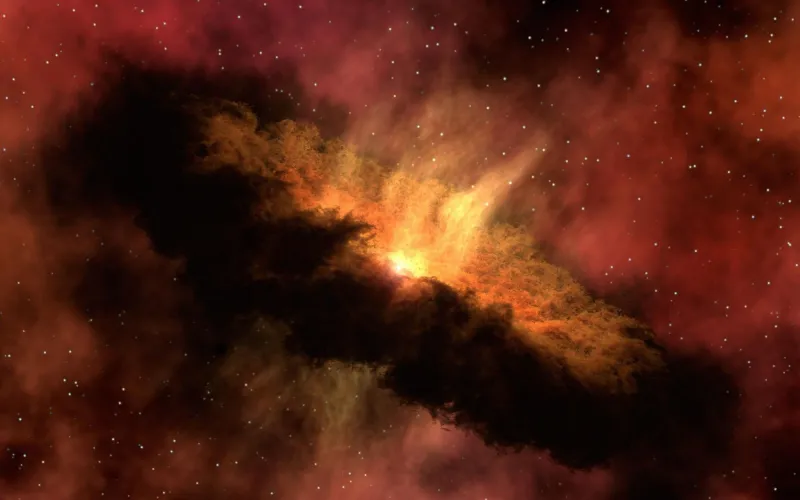
Most black holes have a story we can follow. A massive star burns through its fuel, collapses under its own gravity, and leaves behind a dark, dense remnant that warps spacetime around it. We've detected them through gravitational waves. We've even photographed one. Black holes, as wild as they are, have become almost familiar.
But there's another kind of black hole — one that didn't need a dying star to come into existence. One that may have been born in the first fractions of a second after the Big Bang itself, when the universe was a roiling, chaotic soup of energy and matter. These are called primordial black holes, and despite decades of theorizing, modeling, and searching, we've never actually found one.
Not a single confirmed detection. Zero.
So what exactly are we looking for, why is it so hard to find, and why does it matter so much that we keep trying?
The Universe's First Moments Were Violent Enough to Forge Black Holes From Nothing
Right after the Big Bang, the universe wasn't the orderly, expanding cosmos we observe today. It was extraordinarily hot, dense, and — crucially — uneven. Tiny quantum fluctuations in energy density meant that some regions were packed more tightly than others. In spots where the density was high enough, gravity could have won out over the outward pressure of that expanding fireball, causing matter to collapse directly into a black hole before a single atom had even formed.
These primordial black holes, or PBHs, wouldn't follow the same mass rules as stellar black holes. Depending on when they formed during those first chaotic moments, they could theoretically range from microscopic — smaller than an atom — all the way up to hundreds of thousands of solar masses. That enormous range of possible sizes is part of what makes them so interesting, and so frustratingly hard to pin down.
Stephen Hawking himself did some of the foundational theoretical work on PBHs back in the 1970s, predicting that very small black holes would slowly evaporate over time through a process now known as Hawking radiation. Any PBH with a mass below about a billion tons would have already evaporated by now. But heavier ones? They could still be out there, drifting silently through the cosmos.
The Dark Matter Connection That's Driving Everyone Crazy
Here's where things get genuinely exciting — and a little maddening. Scientists have known for decades that roughly 27% of the universe is made up of dark matter, a mysterious substance that doesn't emit, absorb, or reflect light but exerts a clear gravitational pull on everything around it. We've mapped its effects. We've built our models of cosmic structure around it. But we still don't know what it actually is.
Primordial black holes are one of the most compelling candidates. Unlike exotic subatomic particles — the other leading dark matter suspects — PBHs wouldn't require any physics beyond what we already know. They're made of ordinary matter, just packed so tightly that light can't escape. No new particles needed. No extensions to the Standard Model required.
If a significant fraction of dark matter turns out to be primordial black holes, it would be one of the cleanest solutions to one of physics' biggest open questions. That's the tantalizing possibility driving a lot of the current research.
The catch? Every time astronomers try to close in on where PBHs could be hiding, new observations tighten the constraints and rule out more of the mass range. Finding a window where PBHs could account for all of dark matter has proven incredibly difficult.
So Why Can't We Just Find One?
The detection problem is genuinely brutal. By definition, black holes don't emit light. Primordial ones — especially if they're on the smaller end — would be tiny, isolated, and moving through space without any obvious companions or gas clouds to feed on and light up. There's no glowing accretion disk to spot with a telescope. No dramatic merger to send ripples through spacetime.
Astronomers have tried several clever workarounds.
Gravitational microlensing is one of the most promising. When a massive object passes between Earth and a distant star, its gravity bends and amplifies the star's light in a predictable way. Surveys like the MACHO project and, more recently, the Optical Gravitational Lensing Experiment (OGLE) have scanned millions of stars looking for these telltale brightening events. They've found some interesting candidates, but nothing that definitively confirms a primordial black hole.
Then there's the gravitational wave angle. The LIGO and Virgo detectors have been listening for ripples in spacetime caused by black hole mergers. Some of the mergers detected have involved black holes in mass ranges that are hard to explain through normal stellar evolution — raising eyebrows and prompting speculation about whether PBHs might be involved. It's suggestive, but not conclusive.
Researchers have also looked at the cosmic microwave background — the faint afterglow of the Big Bang that fills the entire sky — for signs that PBHs might have left an imprint during the early universe. And they've searched for gamma-ray bursts that could signal the final evaporation of small primordial black holes. So far, nothing definitive.
The New Tools Giving Astronomers Fresh Hope
The search isn't stalling out — if anything, it's accelerating. The Nancy Grace Roman Space Telescope, NASA's wide-field infrared observatory slated to launch in the next few years, is specifically designed for the kind of massive, sensitive survey work that microlensing searches require. It'll be able to monitor hundreds of millions of stars simultaneously, dramatically improving the odds of catching a lensing event caused by a PBH.
Next-generation gravitational wave detectors, including upgrades to LIGO and the proposed space-based LISA observatory, will extend our sensitivity into mass ranges and merger types we currently can't detect. If primordial black holes are out there merging, LISA might be the instrument that finally hears them.
There's also growing interest in using radio telescope arrays to look for signatures of PBH evaporation, and in mining data from existing sky surveys using machine learning tools that can flag anomalies human researchers might miss.
Why It Would Change Everything
Finding a primordial black hole — actually confirming one — wouldn't just check a box on the cosmic to-do list. It would open a direct observational window into the first milliseconds of the universe's existence, a period we currently can only theorize about. It would give us a new probe of the density fluctuations that seeded all the structure we see in the cosmos today.
And if PBHs turn out to make up even a fraction of dark matter, it reshapes the entire dark matter research landscape. Billions of dollars and decades of effort have gone into searching for exotic particles that may not exist. A PBH confirmation would send the field in a dramatically different direction.
For now, though, they remain the universe's most stubborn secret — objects that may have been forged at the very dawn of time, hiding in plain sight across a cosmos we're only just beginning to read. The search goes on, and honestly? That's what makes it one of the most compelling hunts in all of modern science.