Inside the Stellar Womb: New Telescopes Are Finally Showing Us How Stars Come to Life
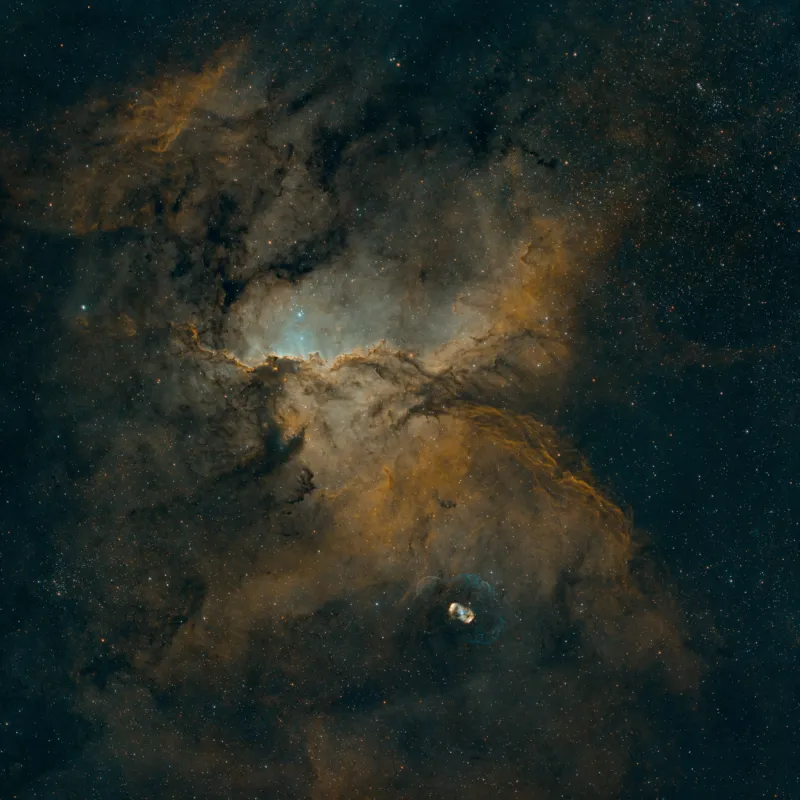
There's a place in the constellation Orion — about 1,300 light-years from your living room — where stars are being born right now. Not metaphorically. Not in some abstract cosmic sense. Right now, as you read this, enormous clouds of gas and dust are collapsing under their own gravity, heating up, and igniting into nuclear furnaces that will burn for billions of years.
For most of human history, we couldn't see any of it. The same dust and gas that cradles newborn stars also blocks visible light like a brick wall. But that's changing fast. A new generation of telescopes — built to see the universe in wavelengths our eyes can't detect — is finally giving astronomers a front-row seat to one of nature's most dramatic performances.
Why Star-Forming Regions Are So Hard to Study
Stellar nurseries, sometimes called giant molecular clouds, are exactly what they sound like: massive reservoirs of molecular hydrogen and dust scattered throughout galaxies. Our own Milky Way is full of them. The Orion Nebula, the Eagle Nebula (home of the iconic "Pillars of Creation"), and the Carina Nebula are among the most famous.
The problem has always been opacity. Visible light simply can't punch through the dense cores of these clouds where the real action happens. It's a bit like trying to watch a surgery through a concrete wall. You know something important is going on in there, but you're completely shut out.
Infrared and radio wavelengths, though, are a different story. They slip right through the dust like it's barely there. And as our instruments for capturing those wavelengths have gotten dramatically better over the past decade, the view inside these cosmic nurseries has gone from blurry snapshots to something approaching high-definition video.
What We're Seeing Now
The James Webb Space Telescope gets a lot of — well-deserved — attention for its deep-field images of ancient galaxies. But some of its most scientifically jaw-dropping work has been right here in our own cosmic backyard, staring into stellar nurseries with its powerful near- and mid-infrared cameras.
In 2022 and 2023, Webb released images of regions like NGC 3324 in the Carina Nebula that showed towering columns of gas being sculpted by radiation from nearby massive stars. More importantly, scattered throughout those images were dozens of previously invisible protostars — baby stars still wrapped in their dusty cocoons, glowing faintly in infrared light.
But Webb isn't working alone. Ground-based radio observatories like the Atacama Large Millimeter/submillimeter Array (ALMA) in Chile have been mapping the internal structure of molecular clouds with extraordinary precision. ALMA can trace the movement of gas at scales small enough to watch individual protostellar disks — the spinning pancakes of material that eventually form planets — take shape around newborn stars.
Together, these tools are giving astronomers something they've never had before: the ability to watch star formation unfold across multiple stages simultaneously.
The Birth Process Is Messier Than the Textbooks Suggest
Here's something the cleaned-up diagrams in astronomy textbooks don't quite capture: star birth is an absolute mess.
When a region of a molecular cloud becomes dense enough, gravity takes over and the cloud starts to collapse. As it does, it heats up and fragments — not into one neat, tidy star, but often into dozens of clumps that compete, collide, and interact in chaotic ways. Massive young stars blast out jets of superheated material along their poles, slamming into surrounding gas and triggering — or sometimes shutting down — the formation of neighboring stars.
Recent observations have shown that these jets, called Herbig-Haro objects, are far more energetic and structurally complex than previously thought. Webb's infrared eyes have captured them in extraordinary detail, revealing knotted, bow-shock structures that look almost like slow-motion explosions frozen in space.
Meanwhile, ALMA has been catching something else entirely: the moment when rotating gas clouds develop what astronomers call "pseudo-disks" — early, chaotic precursors to the orderly protoplanetary disks that eventually give rise to solar systems. Watching this transition happen in real time is, frankly, something researchers a generation ago would have considered impossible.
What This Tells Us About Our Own Sun
This isn't just curiosity for its own sake. Everything happening in those nurseries today is a window into our own past.
Our Sun formed roughly 4.6 billion years ago inside a stellar nursery not unlike the ones Webb and ALMA are studying now. The same process — cloud collapse, fragmentation, protostellar disk formation, eventual ignition of nuclear fusion — played out right here in what would become our solar system.
By watching it happen elsewhere, scientists can test and refine their models of how the Sun formed, how the planets assembled from leftover disk material, and even how the early Earth got its water and organic chemistry. Some researchers believe that the Sun's birth environment — a crowded stellar nursery full of massive, short-lived stars — may have played a direct role in shaping the architecture of our solar system.
Figuring out exactly how is one of the driving questions behind current stellar formation research.
The Next Frontier: Watching a Star Actually Turn On
As impressive as current observations are, there's still one moment astronomers haven't fully captured: the precise instant when a protostar reaches the critical temperature and pressure to ignite nuclear fusion for the first time — the moment it truly becomes a star.
That transition happens deep inside a dusty cocoon, on timescales that are short by cosmic standards but still span thousands of years. Catching it requires not just better telescopes, but better survey strategies — monitoring large numbers of protostars over long periods and looking for the telltale signatures of ignition.
Proposed future missions and continued ALMA and Webb observations are aimed directly at this problem. The goal isn't just to see a star turn on. It's to understand the precise physical conditions that determine whether a collapsing cloud becomes a star like our Sun, a massive blue giant that burns out in a few million years, or a dim red dwarf that might outlive the Milky Way itself.
A Universe Full of Nurseries
One of the more humbling things about all this research is the sheer scale of what's happening out there. Our galaxy alone contains thousands of active star-forming regions. Across the observable universe, stars are forming at rates that dwarf anything happening in the Milky Way today — particularly in the early universe, when the cosmos was younger, denser, and far more chaotic.
Webb is already beginning to study stellar nurseries in distant galaxies, giving us a look at star formation under conditions very different from our own neighborhood. The comparison is helping astronomers understand how environment — the density of surrounding gas, the presence of nearby massive stars, even the metallicity of the cloud — shapes the kinds of stars that form.
Every stellar nursery is, in a sense, a universe unto itself. And for the first time, we have the tools to really explore them.
The dawn of stars — it turns out — is something we can finally watch.